Introduction to Agentic AI
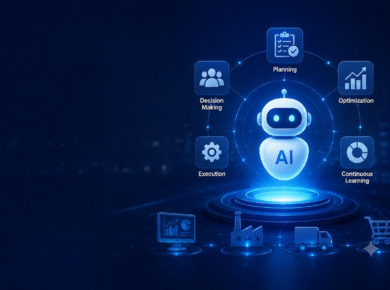
Businesses have always sought efficiency by streamlining manual tasks, connecting different systems, and using smart tools. Today, however, they face a new challenge: just completing tasks faster is not enough. Markets require flexibility, quick responses, and systems that can self-correct. This is where agentic AI comes in. Unlike traditional automation or even generative AI tools, agentic AI systems understand business goals, plan steps to achieve them, execute across systems, and learn from the outcomes. Essentially, companies move from automation, where humans direct machines, to autonomy, where machines operate within goals and limits set by humans.
Evolution of AI: From Generative to Agentic
Generative AI phase: Generative AI tools took hold by dramatically boosting productivity. A 2025 survey shows that 82% of organisations use generative AI at least weekly, with 46% reporting daily use. These systems create content, summaries, and insights and support human decision-making. However, they still rely on human prompts and do not carry out business operations independently.
Agentic AI phase: Agentic AI builds on this foundation and adds new functions. These systems can set or accept goals, such as “reduce support resolution time by 30%.” They break down those goals into tasks, call APIs, update systems, monitor progress, and adjust as needed. They act independently rather than just assisting. Market research forecasts that the global enterprise agentic AI market will grow at a compound annual growth rate of around 46% to 47% from the mid-2020s to 2030. For instance, a latest report estimated the market size at USD 2.58 billion in 2024, increasing to USD 24.50 billion by 2030.
Comparison: Agentic AI vs Generative AI
| Feature/Aspect | Generative AI | Agentic AI |
|---|
| Strategic Role | Content creation engine | Autonomous execution layer |
| Operating Model | Human-driven, prompt-based | Goal-driven, outcome-oriented |
| Decision Responsibility | Relies on user decisions | Makes decisions within defined business guardrails |
| Execution Capability | Produces content but cannot complete processes | Executes multi-step workflows end-to-end |
| Intervention Requirement | High, requires continuous human input | Low, minimal oversight once objectives are set |
| Enterprise Impact | Enhances productivity and creativity | Delivers operational efficiency and business automation |
| Functional Strengths | Content generation, recommendations, insights, summarization | Planning, orchestration, cross-system coordination, action taking |
| Business Value Delivered | Faster content output; improved analysis | Reduced operational overhead; accelerated time-to-value |
| Scalability | Scales with user bandwidth | Scales independently across domains and systems |
| Business Use Cases | Marketing content, product descriptions, reports, customer responses | Supply chain automation, IT operations, data upkeep, process optimisation |
| Outcome Orientation | Output-focused | Result-focused (achieves goals, not just generates work) |
Also read: What is PIM?: How It Works, Why It Matters, and Who Benefits
Core Capabilities of Agentic AI
To operate independently in business environments, agentic systems have several key capabilities:
- Long-term memory and continuous learning – They improve efficiency and accuracy over time based on past results.
- Multi-agent collaboration – Multiple agents can specialize in different functions, such as pricing, supply chain, and customer experience. They work together to reach shared goals.
- Reasoning and self-correction – If an action does not lead to the desired result, the system can adjust its approach without needing human help.
- Goal-driven execution – The system does not perform isolated tasks. Instead, it focuses on business outcomes like better margins, quicker onboarding, and reduced churn.
- System-level integration – Agents connect with ERP, CRM, CMS, commerce engines, marketplaces, and cloud applications through APIs, event signals, and workflows.
These capabilities transform AI into an operational workforce instead of just a tool.
Enterprise Use Cases
The practical use of agentic AI covers various functions and industries. Here are some examples:
- Customer support: – An agent monitors incoming support tickets. It checks product and usage data, takes necessary action like scheduling a fix or issuing a credit, updates systems, and closes the loop automatically.
- Procurement and supply chain decision-making – Agents detect demand changes in real-time. They trigger replenishment orders, reroute shipments, and update forecasting models. This helps reduce delays and costs.
- Commerce optimization and dynamic pricing – In e-commerce, agents review competitor pricing, inventory levels, and campaign performance. They autonomously adjust prices and promotions to improve margin and turnover.
- Product data enrichment and classification – Agents update product metadata, ensure quality, syndicate content, and control version changes without needing manual oversight for each SKU.
- Automated compliance and quality checks – Agents continuously monitor regulatory changes. They audit system logs, raise or escalate issues, update policies, and track remediation.
- End-to-end workflow across departments – An incoming lead triggers agents in marketing, sales, fulfillment, and customer service. Each agent executes its tasks autonomously and hands off smoothly.
These use cases demonstrate how agentic AI changes not just tasks but entire operational processes.
Impact on Digital and Operational Landscape
The adoption of agentic AI drives significant operational and organizational shifts:
- Workforce transformation – Employees evolve from doing repetitive tasks to supervising agents, setting guidelines, and managing exceptions. This increases productivity and job satisfaction.
- Rise of AI-orchestrated business processes – Agents coordinate tasks between systems, replacing traditional manual workflows and reducing the time between decision and action.
- Decline of human-driven manual workflows – The need for human coordination decreases; agents handle handoffs, update systems, and escalate issues only when necessary.
- Impact on KPIs – Organizations using agentic AI report:
- Faster time to market for new offerings.
- Lower operational cost per transaction.
- Improved accuracy of decisions.
- High scalability without proportional workforce growth.
For example, a market source estimated businesses adopting agentic AI could see up to 40% cost reduction and 20–30% revenue growth.
Risks and Challenges:
Enterprises must still address important considerations while adopting Agentic AI:
- Data security and system access boundaries – Agents acting on their own across systems mean access must be closely controlled and monitored.
- Governance for autonomous decisions – Businesses need to keep audit trails, approval processes, and accountability, even when machines are executing tasks.
- Model explainability – If agents operate without human oversight, companies must still understand the reasoning behind decisions to meet compliance and trust obligations.
- Ethical and regulatory constraints – Autonomous decisions may lead to issues. Bias, fairness, and following regulations require careful design and monitoring.
- Aligning AI goals with business objectives – Deploying agents without a clear link to strategic goals can lead to wasted investment or unintended outcomes.
An analyst notably predicted that over 40% of agentic AI projects may be canceled by 2027 due to unclear business value.
Investment and Execution Roadmap
For chief technology and innovation leaders, a structured roadmap helps realize value.
- Foundation, data readiness and enterprise knowledge modeling – Clean, unified data and semantic models provide the backbone for agents to reason correctly.
- Integration, business systems, APIs, tool chains – Agents must have unrestricted access to enterprise systems, like ERP, CRM, and commerce platforms, through strong APIs and event streams.
- Agent orchestration and monitoring layer – This layer manages the agent lifecycle, communication, versioning, performance monitoring, and exception handling.
- Human oversight and approval workflows – Even the most capable agents need guidelines. Humans must set goals, monitor outcomes, and step in when necessary.
- Measuring ROI in autonomous environments – Instead of just tracking cost reduction from automation, KPIs should include the speed of decision-to-action, rate of autonomous task completion, and volume of error-free transactions.
The Future, Autonomous Enterprises
The vision ahead is exciting. In five to ten years, businesses could have digital operations that:
- Run continuously and improve on their own without constant human help.
- Use agents as a digital workforce, reacting to goals, market changes, and system signals in real time.
- Move from “AI-assisted work” to “AI-executed work.” Humans will focus on strategy, ethics, and innovation while machines handle execution, coordination, and improvement.
- Operate at scale, speed, and cost efficiency that seems impossible under traditional models.
Companies that embrace this change early will set the standards for responsiveness, competitive agility, and operational insight.