How Agentic AI Is Transforming Enterprise Operations Beyond Automation For CIOs, CTOs,
For CIOs, CTOs, Chief Data Officers, and Enterprise Operations Leaders
Most enterprises spent the last decade automating tasks. They built RPA bots, deployed workflow engines, and connected systems. It worked for the straightforward 60% of operational work that is structured, predictable, and rule-bound.
The remaining 40% never got automated. Except for handling, cross-system judgment calls, unstructured data, ambiguous customer requests that work stayed with humans because no tool could handle the interpretation it required. Until now. Agentic AI is specifically built for that remaining work. And it’s moving from pilot to production faster than most enterprise teams anticipated.
But there’s a gap between the category’s potential and how most organizations are approaching it. Understanding what agentic AI is and what it is not is the difference between a successful deployment and a cancelled project.
Traditional automation is excellent at what it was designed for: moving data between systems, applying fixed rules, executing structured workflows at scale. But it has no judgment. When something outside the script happens a missing field, an unexpected value, an ambiguous customer request it either breaks or escalates to a human.
That limitation created real operational drag. The exceptions that don’t fit the rules typically 10 to 15% of all transactions consume a disproportionate share of analyst time. They’re the backlog that never fully clears.
Gartner projects that over 40% of agentic AI projects will be cancelled by end of 2027 — not because the technology doesn’t work, but due to unclear business value, rising costs, and inadequate risk controls.
That cancellation rate is not a verdict on agentic AI. It’s a verdict on how most organizations are adopting it: chasing the category before they understand it, buying orchestration platforms before their data is ready for an agent to reason over, and measuring success in demos rather than decisions.
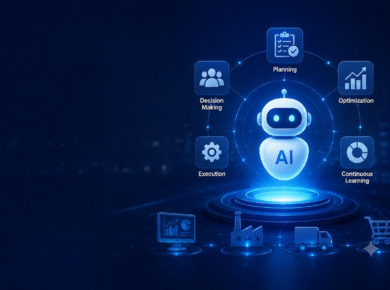
Here is the distinction that matters. Generative AI produces content text, summaries, code in response to a prompt. Agentic AI acts. It can call APIs, query databases, trigger downstream systems, evaluate the result of its own actions, and adjust what it does next based on what it finds.
An agent doesn’t just respond to a customer email. It reads the email, determines intent, checks the order system and account history, decides on a resolution, executes it, and only escalates to a human if its confidence drops below a defined threshold. That’s a fundamentally different software pattern goal-pursuing rather than instruction-following.
IBM’s research found that AI agent adoption is set to triple in the next two years, with executives expecting autonomous, self-directed systems to become central to operations rather than peripheral to them. The enterprises positioning now are not doing it because it is trendy. They are doing it because the judgment-heavy work that automation left untouched is exactly where the next wave of operational efficiency lives.
Strip away the marketing language and a functioning enterprise agentic AI system has four working parts:
This interprets the goal, breaks it into steps, and decides what to do next based on intermediate results. Modern large language models can now complete genuinely useful multi-step chains of work not just answer single questions.
The agent needs governed, permissioned access to call APIs and query enterprise systems your ERP, your PIM, your CRM, your data warehouse. Without this, an agent can reason but cannot act.
Short-term memory for the current task, and often retrieval against an enterprise knowledge base. This is what allows an agent to carry context across a multi-step workflow rather than starting from scratch at each step.
This is the layer most pilots underinvest in — and where most cancellations originate. It sequences multi-agent workflows, enforces permission boundaries, logs every decision for audit, and defines when a human must approve before the agent proceeds. A generative AI hallucination produces bad text. An ungoverned agent can take bad action: approve a payment, send a customer communication, modify a record. The governance bar is categorically higher.

The use cases that are generating real, measurable results share a common profile: judgment-heavy, exception-driven work that automation never touched.
Order and exception management
Agents cross-reference inventory, customer history, and shipping data to resolve straightforward exceptions autonomously and route only genuinely ambiguous cases to a person. The result: faster cycle times and a significant reduction in the queue of unresolved exceptions that consumes analyst attention.
Product data enrichment and stewardship
Agentic workflows detect missing or inconsistent product attributes, draft enrichments against brand guidelines, and route only edge cases for human approval. For organizations with a governed PIM foundation, this compounds: the agent’s decisions improve as the underlying data quality improves. For organizations without one, the agent inherits whatever inconsistencies exist in the source data and acts on them at machine speed.
Customer service triage
Agents authenticate a customer, pull order and account history, determine the appropriate resolution path, and execute it without a human touching every ticket. Escalations happen only when the agent’s confidence drops below a defined threshold.
Agentic commerce readiness
As B2B and B2C buying increasingly involves AI agents querying product catalogs on a buyer’s behalf, product data structure and completeness directly determines whether a brand’s products get found, recommended, and selected. Clean product data has always mattered. In an agentic commerce environment, it becomes a revenue-relevant capability.
When agentic AI is deployed on a solid foundation, the operational benefits are concrete:
The common thread in successful deployments is not the model selected, or the orchestration platform chosen. It is data quality and governance discipline.
Agentic AI represents a genuine architectural shift — from systems that execute instructions to systems that pursue goals. That shift unlocks real value in the judgment-heavy, exception-driven work that automation never reached. But it raises the stakes on everything underneath it.
The data and AI strategy question is not whether to adopt agentic AI. Most enterprises are already being pushed toward it by the economics of their remaining operational inefficiencies. The question is whether the foundation — the master data, the product information, the governance architecture — is ready to support autonomous decision-making at scale.
The enterprises that will lead in 2026 and beyond are not the ones with the most ambitious agentic pilots. They are the ones that quietly got their data foundation right first and then layered autonomous decision-making on top of it.
If you’re evaluating where your organization sits on that readiness curve,
Innowinds works with enterprise teams across Agentic AI, Generative AI, Data & AI Strategy, Master Data Management, and Product Information Management to build the foundation agentic systems actually depend on.
Agentic AI refers to AI systems that can independently plan, decide, and take multi-step actions to reach a goal, rather than just responding to a single prompt or following a fixed script.
RPA follows fixed, pre-programmed rules and breaks when it encounters something outside that script. Agentic AI uses reasoning to handle ambiguity, make judgment calls, and adapt its next action based on intermediate results.
Generative AI produces content — text, images, summaries — in response to a prompt. Agentic AI takes that further by acting calling tools, querying systems, and executing multi-step tasks toward a defined goal.
Order and exception management, product data enrichment, customer service triage, master data stewardship, and supply chain/procurement coordination are currently the highest-value, most proven use cases.
Most commonly: poor underlying data quality, unclear decision boundaries, inadequate governance and audit controls, and unclear or unmeasurable business values, not a fundamental flaw in the technology itself.
Not strictly, but in practice, agents reasoning over inconsistent, duplicate, or fragmented product and customer data will make confidently wrong decisions. Governed master and product data significantly improves agent reliability.
It’s the coordination layer that allows several specialized AI agents to hand off tasks to each other within a larger workflow — for example, one agent gathering data, another evaluating it, and a third executing an action.
Beyond simple time-saved metrics, look at decision quality (do agent decisions hold up under review), reduction in human escalations, and resolution of previously unaddressed long-tail exceptions.
Audit trails for every autonomous decision, clearly defined permission boundaries, explicit human-escalation thresholds, and accountability mapping for when an autonomous action turns out to be wrong.
Yes — as AI shopping agents increasingly query product catalogs on a buyer’s behalf (agentic commerce), the structure, accuracy, and completeness of product data directly affects whether a brand’s products get found and selected.
How Agentic AI Is Transforming Enterprise Operations Beyond Automation For CIOs, CTOs,
How to Build a Trusted Enterprise AI Foundation A Strategic Guide for
How Pimcore Is Pioneering AI-Driven Agentic PXM: Unlocking Intelligent Experiences for Enterprises
Product Master Data Model: The Complete Enterprise Guide to Structuring, Governing, and
PIM ROI Calculator: How to Build a Financial Business Case for PIM
Dirty Data Is Killing Your Manufacturing Operations Read Blog You've Already Invested
MDM as the Enterprise Data Nerve Center for Value Creation Read Blog
Why Golden Records Are Essential for a Successful Master Data Management (MDM)
Why Agentic Commerce Needs Real-Time Product Data to Succeed? Read Blog Executive
How to Measure ROI from MDM Investments? Read Blog Overview: Master Data